A Model does not know that it is connected to a (set of) controllers, because this knowledge implies the knowledge of the GUI semantics, which should be out-of-scope for the Model.
Nevertheless, sometimes it is necessary for a Model to communicate to the GUI logics (generally the Controllers set) that the model state changed. This communication can be implemented by the Observer pattern, that provides a mechanism where Observers are notified when observed state in the model get changed.
Even if models are typically observed by the GUI logics, the mechanism can be used also to decouple (isolate) models and other entities in the application logics. For example, models can be observed by other models.
In pygtkmvc Models' state has been extended with a mechanism called Observable Properties. An observable property is a part of the Model state which is also externally observable via an Observer. Every time an observable property changes, any interested Observer will be notified of the event.
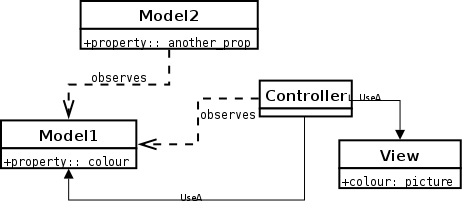
Figure 3 shows a Model (Model1) containing an observable property (color). There are also a Controller and a View (to show the colour), and the Controller is also an observer of Model1. Furthermore, there is another Observer that is model Model2, whose state the designer wanted to make dependent on the state of Model1, but without explicitly coupling the two models.
When the property color changes for example to red, all connected Observers will be notified. Each observer will then perform the necessary operation according to the respective logics. For example, the Controller will make the connected View showing the occurred change.
Each Observer declares it is interested in receiving notifications on one or more properties changing, by a mechanism called Registration. Once an Observer (for example, a Controller) registered itself among the Model it is associated with, it will be notified of all changes of the observable properties. The Observers will be notified only of the property changes that they are actually interested in observing.
An implicit syntactical rule binds observable properties names to notifications sockets inside Observers. This rule allows an automatic connection, and fixes a sort of ``rule'' for methods names.
Later in this document, some implementation details are discussed, and further details about observable properties are presented. Finally, an example in the latest part should make all these concepts clearer.
Adapters (see section 7 are powerful entities that can be used to automatically bind part of the view with part of the model with aminimal effort, without any need to couple with complex code and naming rules. However, Adapters should be used only after all the ``manual'' mechanisms have been well understood, and for this reason they are presented only at the end of this manual.